Skip to content
maxnews
Rankings

The Complicated History Of The Infamous "Sobbing Woman Saluting" Photo

Images can be deceiving and one of the most misinterpreted and misrepresented images of the 20th century is of a crying woman giving the “Heil Hitler!” or “Sieg Heil” salute. Taken in 1938, the picture is frequently presented in a clipped version, one that doesn't reflect the whole situation. The crying woman is often believed to be crying in anguish at the arrival of German forces. Her tears, while certainly a reflection of intense emotion, are not ones of clear sadness. In fact, it's more likely the case that the her cries are out of relief and joy. The Sudetenland where the woman in the photo lives was heavily German in its leanings and in its population. And, while the German occupation of Sudetenland may have been welcomed at the moment the image was taken, that does not reflect the complex situation at hand. Ultimately, the picture may only prove that a salute isn't just a salute – just as tears aren't always just tears.

Entries
4
Votes
0
Updated
yesterday

Tap upor downto vote. Your vote is added to Ranker's counts.

Voting identifies your browser with an anonymous fingerprint, stored only as a salted hash, to count one per visitor. Privacy

Source: Ranker, ranked by its voters.

  1. 1

    The Image Of The Weeping Woman Was Taken After Germany Invaded Her Homeland
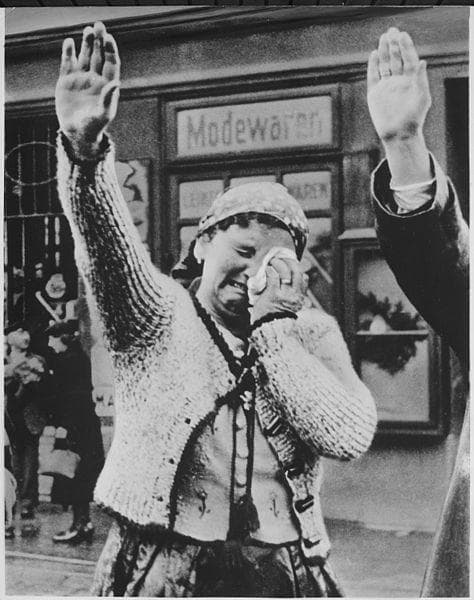
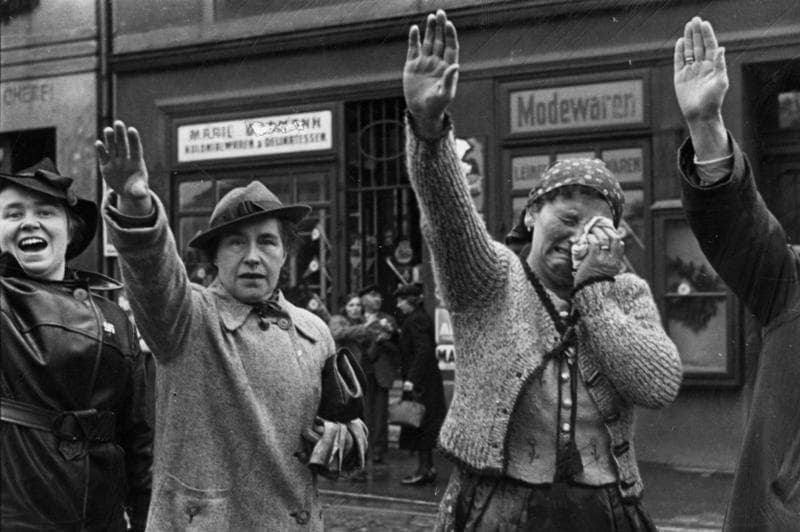
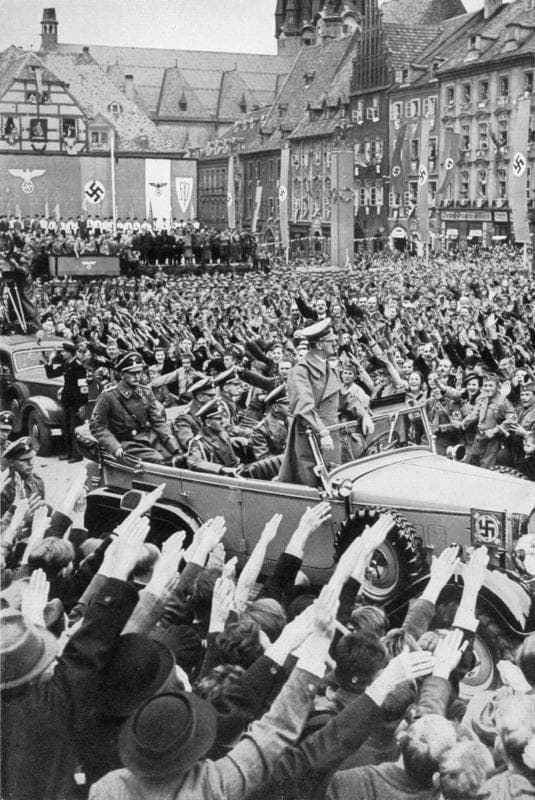
    In 1938, British Prime Minister Neville Chamberlain set the tone for for how to react to the ambitions of Adolf Hitler and the Nazi Party in Germany. Appeasement, as it is called, was undertaken with the signing of the Munich Agreement between Germany, Italy, France, and Great Britain. According to the document, Germany would take control of Sudetenland, the part of Czechoslovakia closest to Germany where millions of people of German origin lived. In exchange, Hitler would end its aggression toward the rest of Czechoslovakia. Hitler backed out of the Munich Agreement months later, by which time Germany had already taken control of the border city of Cheb (Eger) in Sudetenland. Shortly after the image of the woman crying as she offered the Nazi salute was taken in October 1938, it appeared in the National Socialist Newspaper, Völkischer Beobachter.
    0% upvoted
  2. 2

    The Crying Woman Was Not The Only Person Watching As The Germans Passed By

    The clipped version of the image taken in October 1938 in Cheb (Eger) is well-known, but it's only part of what actually took place on the day the Nazis took control of the city. Sudetenland had about three million individuals with German roots as residents. As the woman crying salutes Hitler and Germany, she's accompanied by others doing the same. Next to the women are two others, one with a fairly passive look on her face and another with what looks to be a smile. The overall reception of German troops in Sudetenland is difficult to tease out after decades have passed, but based on other images from Cheb at the time, there was a generally enthusiastic tone. In one image, crowds of excited individuals similarly salute Hitler as he passes, while still one more image shows soldiers smiling for the camera. That said, after Hitler violated the Munich Agreement, moved further into Czechoslovakia, and announced the creation of the Protectorate of Bohemia and Moravia, the country essentially ceased to exist by March 1939.

    0% upvoted
  3. 3

    Her Tears Were Widely Interpreted As Sorrow And Fear

    From one perspective, the image of the weeping woman saluting Hitler was a testament to the anguish and sadness she felt at the loss of her homeland. The National Archives, for example, labels the image as follows: The tragedy of this Sudeten woman, unable to conceal her misery as she dutifully salutes the triumphant Hitler, is the tragedy of the silent millions who have been `won over' to Hitlerism by the `everlasting use' of ruthless force. In 1945, Time printed a letter from one US serviceman in response to the image, which the magazine had run in 1939. According to US Navy Lieutenant Earle A. Cleveland, The Nazi explanation was that here were portrayed the intense emotions of joy which swept the Sudeten Germans as Hitler crossed the Czech border at Asch and drove through the streets of the nearby ancient city of Eger, 99% of whose inhabitants were ardently pro-Nazi Sudeten Germans at the time. Cleveland also pointed out that Time mispresented the images as having been taken in Prague six months after Sudetenland was taken. Time issued a correction for its mistake, but it didn't end use of the image as what it called “Allied propaganda.”

    0% upvoted
  4. 4

    The Image Was Pro-Third Reich Propaganda But Ultimately Reflected False Promises

    While the Allies used the images of the weeping woman as propaganda for one side (or presented it as neutral, at best), the Third Reich used it for another. On the whole, the Nazi invasion of Czechoslovakia and other parts of Europe were part of the extension of German living space or Lebensraum. German expansion into Austria, the Anschluss, earlier in 1938 set the stage for the movement into Sudetenland. When Germany continued its efforts to expand, actions like what took place at Cheb were essential to its success. In preparation for the arrival of German forces, local Czechoslovakian police were disarmed and abandoned the area, opening it up for German occupation. When Germany took over Sudetenland, there was a large German presence. With the takeover, however, Jews in the Sudetenland became increasingly became the targets of aggression from the Third Reich. And Germany didn't stop with Sudetenland, it soon had control of the entirety of Czechoslovakia. Additionally, Once Germany established the Protectorate of Bohemia and Moravia, “so-called German municipalities were to be provided with electricity, raw materials and loans in preference to 'Czech municipalities.” As a result, The occupation experience splintered and frustrated German patriots [and] the Czech national movement crystalized as perhaps never before.

    0% upvoted